The future of IT services is being rewritten by a simple mismatch: AI is changing how software gets built much faster than the industry is changing how that work is sold. For decades, IT services ran on one equation: more work meant more people, and more people meant more billing. AI puts that equation under pressure, even though demand remains strong. Gartner’s July 2026 forecast expects worldwide IT spending to reach $6.37 trillion in 2026, up 14.2%. The real question is what buyers will expect in return for that spend.
In this guide, we set out ten predictions for the future of IT services in the AI era. They come from what we see while building software at Intellinez and from what analysts and researchers are publishing, including the places where the evidence is still mixed.
What Is Changing in the Future of IT Services?
Quick Answer: The future of IT services is a shift from selling effort, meaning hours and headcount, to selling outcomes, meaning measurable business results. AI-assisted development shortens delivery, small senior teams do more, working prototypes replace long proposals, and clients expect partners to stay accountable after launch.
Analysts are already describing this shift. IDC expects that by 2029, 30% of global IT services will be delivered as productized, platform-enabled offerings, driven by demand for speed, transparency and agentic AI orchestration. In other words, the custom, people-heavy project is no longer the only way the IT services industry reaches a client.
PwC describes what the delivery side can look like: small pods of five to seven engineers, rolling backlogs instead of fixed sprints, and AI handling repeatable work while people focus on architecture, judgment and outcomes. Whether or not a company adopts that exact model, the direction is clear. Buyers are getting used to seeing working software quickly, and they are starting to ask why a project needs so many people and so many months.
Good teams have been moving this way for years, as our guide to modern software development explains. AI-assisted development accelerates it. Two notes before we begin: these are predictions, not certainties, and wherever we use data, we say what it does and does not show.
10 Predictions Shaping the Future of IT Services in the AI Era
Here are the ten shifts we expect to define the future of IT services, roughly in the order buyers will feel them.

1. Faster Execution Becomes the Baseline
Projects that once took six to twelve months will increasingly be expected in weeks. AI-assisted development, reusable components and better tooling all compress delivery timelines. In one controlled experiment, developers with an AI pair programmer finished a JavaScript server task 55.8% faster than a control group. That was a single, narrow task, so treat it as a signal rather than a promise. Still, clients who see results like this will begin to expect speed. We have written about how AI tools go from idea to app in hours, and our Mahrte Tactical case study shows a custom platform delivered in six weeks.
2. Less Planning, More Building
The traditional chain of discovery, requirements, analysis, approvals and development will become much leaner. Clients will prefer a simpler loop: build something, show it, get feedback, improve it. Instead of spending months documenting every possible requirement upfront, teams will let a working version reveal what people actually need. Our own project approach already puts UI designs, interactive prototypes and an MVP in front of clients before full development begins. Leaner does not mean careless, though. Regulated environments will still need documented decisions, and a good partner keeps that discipline while cutting the waiting.
3. Outcome-Based and Hybrid Pricing Will Grow
A quote built on ten developers, six months and an hourly rate will become a harder sell. Clients care about business outcomes. Can you cut processing time by 70%? Can you automate a team’s repetitive work? Can you improve conversion? Can you give management better visibility into the business? Pricing will increasingly reflect the value delivered, not just the number of engineers deployed.
The data suggests a gradual move, not an overnight one. An AlixPartners review of 65 software companies found only four where the vendor bears the risk, meaning fully outcome-based pricing. In 53, the customer bears the risk, and eight share it. CGI describes pricing that increasingly combines a fixed base, variable AI consumption and outcome-based incentives, and notes that no single model has become the standard. A Futurum survey from the first half of 2026 found that 43% of buyers of AI-driven software prefer consumption-based models, against 27% who favor outcome-based ones. So expect outcome-based elements layered onto fixed or hybrid pricing, rather than pure pay-per-result contracts everywhere.
4. Smaller Teams Will Deliver Bigger Projects
We expect a strong AI-native team of five to ten people to deliver, increasingly, work that once needed dozens. Team size will stop being a proxy for capability. The PwC model above is built around small pods rather than large teams, which reflects the same idea. The caveat is scope. This works best on well-defined products and workflows. Very large, heavily regulated or legacy-bound programmes will still need scale, coordination and specialist depth.
5. Senior Talent Will Matter More Than Headcount
AI makes an excellent engineer more productive, which raises the value of what AI does not supply: architecture, product thinking, business understanding and engineering judgment. A Business Standard opinion column describes new roles emerging in enterprise IT, such as agent engineers, architects who decide how humans and agents divide the work, and AI governance specialists, each pairing technical depth with domain knowledge. We expect delivery teams with fewer people and a higher share of experienced ones. For buyers, the practical question shifts from “how many developers?” to “who is making the decisions?”
6. Domain Expertise Becomes a Major Differentiator
Knowing how to code will no longer be enough. Understanding how a manufacturer runs its plant, how a hospital manages workflows, how a logistics company tracks operations or how a professional-services firm runs its business becomes a real advantage. The winning IT companies will combine domain knowledge, engineering and AI. That is why industry context shapes our work, from AI in manufacturing to document-heavy professional services.
7. Prototypes Come Before Proposals
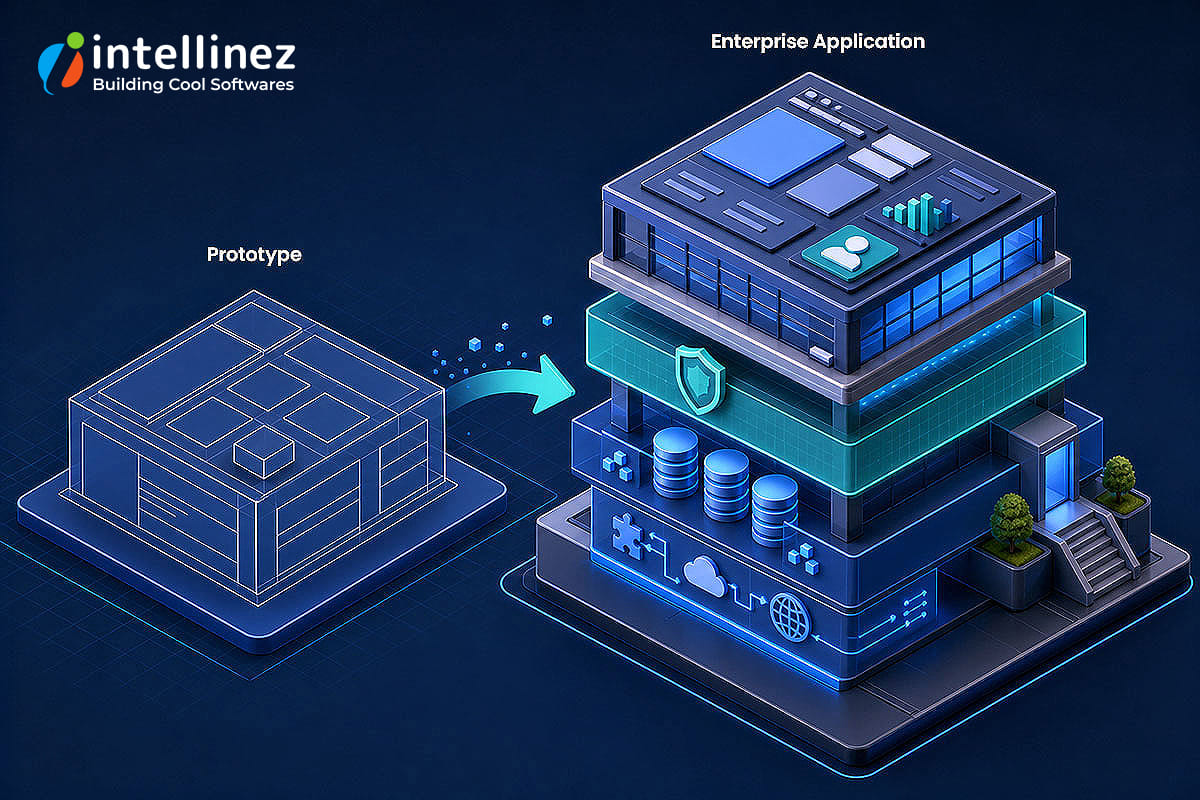
Instead of a fifty-page proposal describing what could be built, clients will expect to see something working. A functional prototype in a few days may become part of the sales process itself. At Intellinez, we aim to show clients a working prototype within 72 hours of kickoff. A prototype is not a product, though. The distance between a convincing demo and secure, scalable software is real, which is why we wrote about the journey from an AI MVP to production-ready enterprise application. Prototypes win trust; engineering keeps it.
8. Custom Software Becomes Attractive Again
For years, SaaS won on speed and cost because custom software was slow and expensive. AI is changing that equation. Businesses will increasingly ask a fair question: why change our process to fit software when software can be built around our process? Well-scoped custom web applications are becoming a more realistic option. The gains are not automatic, though. Fabrity’s analysis notes that faster engineering may create more capacity, better quality or wider scope rather than a smaller budget, and that custom software needs product ownership and long-term funding after launch. Often the smartest move is not rebuilding a whole platform, but building focused custom capabilities where they create an edge.
9. Vendors Will Be Expected to Own the Outcome After Launch
Building an application and handing it over will not be enough. Clients will expect partners to help with adoption, automation, infrastructure, security, performance, analytics, AI integration and continuous improvement. The relationship moves from software vendor to technology partner. This is why we organize our work around four ideas, Build, Run, Support and Advise, instead of stopping at go-live. Software that nobody adopts has not solved anything, however well it was built.
10. The Biggest Change: IT Services Stop Selling Manpower
The future of IT services looks different from its past. The industry has historically followed one equation: more work, more people, more billing. AI breaks that link. The next generation of IT services companies will look different: smaller teams, faster execution, fewer meetings, more prototypes, more automation, more accountability and outcome-based or hybrid pricing. Clients will care less about how many people worked on a project and more about one question: did it solve the business problem?
The Old Model vs. the AI-Era Model of IT Services
Here is how the future of IT services differs from the traditional model across the areas buyers feel most.
Pricing
- Traditional: Effort-based estimates built on hours and headcount
- AI era: Fixed and outcome-linked pricing
Team
- Traditional: Large teams, with size used as a signal of capability
- AI era: Small, senior, AI-native teams
Planning
- Traditional: Long discovery and requirement phases before anything is built
- AI era: Build, show, get feedback, improve
Proof of capability
- Traditional: Long proposals and references
- AI era: A prototype early in the conversation
After launch
- Traditional: Handover, then a separate support contract
- AI era: Shared accountability for adoption and continuous improvement
Main differentiator
- Traditional: Engineering capacity
- AI era: Domain expertise combined with engineering and AI

What the Evidence Says, and Where It Is Still Mixed
Strong predictions about the future of IT services deserve honest scrutiny. Three points stand out.
Speed gains are real but uneven – The 55.8% figure above comes from a narrow, timed task. By contrast, a randomized trial by METR followed 16 experienced open-source developers across 246 real tasks in mature codebases. It found that early-2025 AI tools made them 19% slower, even though they had expected to be 24% faster and afterwards believed they had been 20% faster. In February 2026, METR published an update saying developers are likely more sped up by newer tools, while warning that its newer data is only weak evidence because of selection effects. The lesson is that AI speeds up delivery when teams redesign how they work, not when a tool is simply added on top.
Pricing is moving slowly– As the AlixPartners and CGI findings above show, blended structures are more common today than pure outcome-based contracts.
Demand is not the issue – The Gartner forecast shows IT spending still rising, so the change in the future of IT services is about how work is delivered and priced, not whether it is needed.
How to Prepare for the Future of IT Services: A Practical Framework
Quick Answer: To prepare, define the business outcome first, ask for a prototype before committing, choose a pricing structure that shares risk, confirm who makes the senior decisions, and plan for adoption after launch. Providers should do the same in reverse: sell results, show proof early and stay accountable.
Step 1: Define the outcome
- What to do: State the business result in measurable terms, such as hours saved or processing time reduced, before discussing technology.
- Key question: How will we know it worked?
Step 2: See it working
- What to do: Ask for a prototype or demo built around your real workflow.
- Key question: What did we learn from it that a document could not tell us?
Step 3: Share the risk
- What to do: Agree a shared-risk price with clear milestones and success criteria.
- Key question: What happens if the agreed result is not delivered?
Step 4: Check the people
- What to do: Confirm who makes architecture and security decisions, and what domain experience they have.
- Key question: Who is accountable for the design?
Step 5: Plan for after launch
- What to do: Agree adoption, support, security and improvement responsibilities before the build starts.
- Key question: Who owns the system in month six?
Best-Practices Checklist for the AI Era
- Write the business outcome down before choosing the technology or the team.
- Ask every vendor for a live demo, not only a proposal.
- Prefer fixed-price or hybrid structures with clear success criteria over open-ended hourly billing.
- Look for senior engineers who own architecture, security and quality decisions.
- Check whether the partner understands your industry, not only your tech stack.
- Treat a prototype as a starting point and budget for production-grade engineering.
- Confirm you will own the code, data and hosting environment.
- Agree who handles adoption, support and improvement after go-live.
- Measure results against the outcome, not against effort or activity.
Key Takeaways
- The future of IT services is a move from selling effort to selling business outcomes.
- Outcome-based and hybrid pricing are growing, but pure outcome-based contracts are still rare.
- AI-assisted development can speed delivery, but gains depend on how teams redesign their workflow.
- Small, senior, domain-aware teams will matter more than large headcounts.
- Prototypes are replacing long proposals, but they still need production engineering.
- Clients will expect their partner to own adoption and results after launch.

Conclusion: Preparing for the Future of IT Services in the AI Era
The future of IT services will not be decided by who has the biggest team. It will be decided by who solves the business problem fastest, most reliably and most accountably. AI compresses the first mile of building software, but judgment, domain understanding and long-term ownership matter more, not less. Buyers who ask for outcomes, prototypes and shared accountability will get more from any partner. Providers who adapt their pricing, team shape and post-launch responsibility will be the ones clients keep.
Thinking about how the future of IT services affects your next software project? Book a free discovery call with Intellinez and we will help you define the outcome you want, agree a fixed price and show you a prototype.
Ready to Build for Outcomes, Not Hours?
Book a free discovery call. We will help you define the outcome you want, agree a fixed price and show you a prototype.
Book a Free Discovery CallFAQs
1. What is the future of IT services?
The future of IT services is a move from selling effort to selling outcomes. Expect faster delivery, smaller senior teams, prototypes before proposals, outcome-linked pricing, and partners who stay accountable after launch.
2. How is AI changing IT services?
AI is changing IT services by compressing build time, reducing the team size needed for well-scoped work and shifting value toward architecture, judgment and domain knowledge. The effect depends on how teams redesign their workflow, not just on the tools they buy.
3. Will AI replace IT services companies?
AI is more likely to change what IT services companies sell than to remove the need for them. Gartner still expects worldwide IT spending to grow in 2026, and the demand is shifting toward partners who deliver outcomes and own results.
4. What is outcome-based pricing in IT services?
Outcome-based pricing ties what a client pays to an agreed business result, such as time saved or conversion improved, rather than to hours worked. In practice it is often combined with a fixed base price, which is why it is often described as a blended model.
5. Is outcome-based pricing replacing hourly billing?
Not entirely yet. An AlixPartners review of 65 software companies found only four with fully outcome-based pricing, so most providers still mix fixed, usage and outcome elements.
6. What is an AI-native engineering team?
An AI-native engineering team is a small group that uses AI across the whole delivery process while senior engineers keep control of architecture, quality and security. PwC describes pods of five to seven engineers as one version of this model.
7. Can smaller teams really deliver bigger projects?
Smaller teams can deliver more on well-scoped products and workflows, but not on every project. Large, regulated or legacy-heavy programmes still need scale, coordination and specialist depth.
8. Why will senior engineers matter more with AI?
Senior engineers matter more because AI can produce code quickly but does not replace judgment about architecture, security and business fit. Their decisions determine whether fast output becomes dependable software.
9. Is custom software better than SaaS in the AI era?
Custom software can be the better choice when your process is a source of advantage and a standard tool forces workarounds. It is not automatically cheaper, because it needs ownership and funding after launch, so many firms build focused capabilities rather than whole platforms.
10. What should businesses look for in an IT services partner now?
As the future of IT services shifts toward outcomes, look for a partner that defines the business outcome first, shows a working prototype early, prices with shared risk, has senior people making the decisions and stays accountable for adoption after launch.