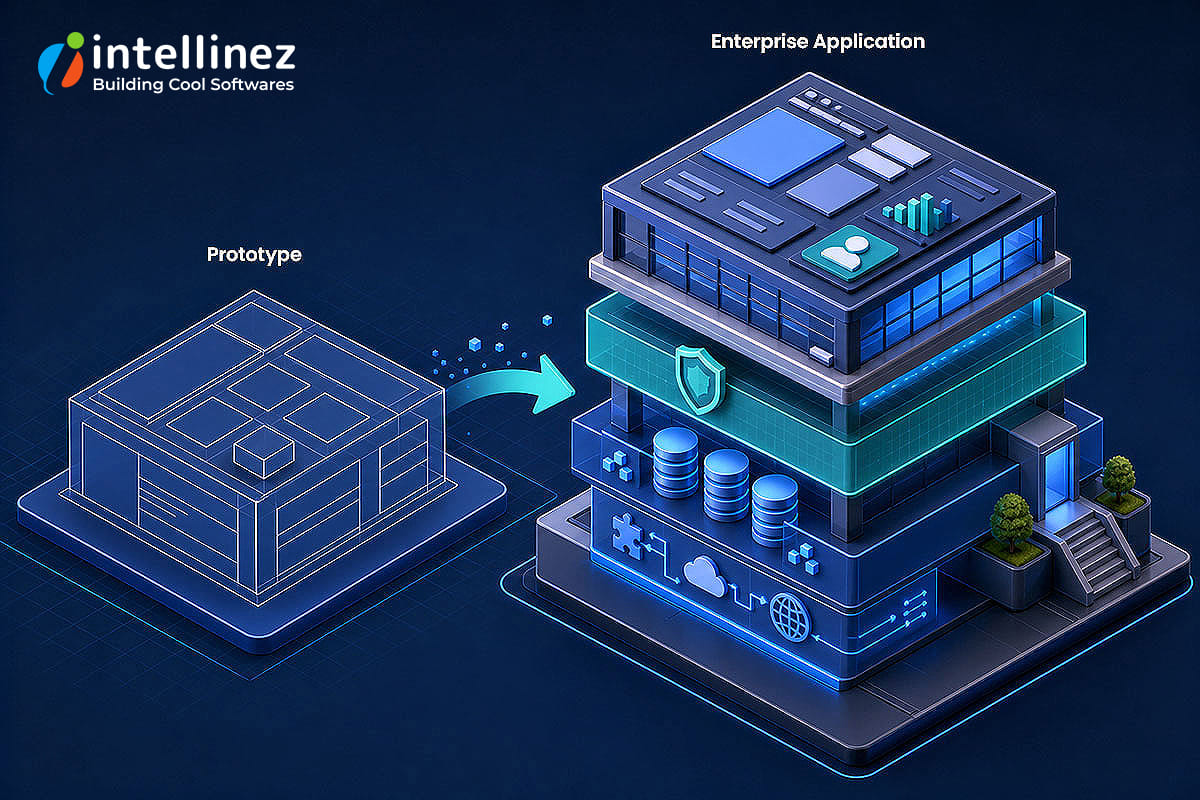
Ask any engineering leader today how fast they can get a working prototype in front of stakeholders, and the honest answer has changed dramatically. Tools like Claude Code and Lovable can take a product idea and turn it into a functioning app in an afternoon. That part isn’t in dispute anymore. What enterprises are actually wrestling with is the next question: how do you take an AI MVP to production-ready enterprise application status without inheriting risk you can’t see yet? That gap — between something that works in a demo and something that’s genuinely production-ready — is where most AI-assisted projects quietly stall.
What “Production-Ready Enterprise Application” Actually Means
| Quick Answer: An AI MVP becomes a production-ready enterprise application once it has proper architecture, access control, audit logging, error handling, observability, backup and recovery, and deployment discipline — not just working features. A demo proves an idea; the finished system still has to hold up under real users, real data, and real accountability. |
It’s worth being precise about this distinction, because it’s easy to conflate “it works” with “it’s ready.” A prototype that lets a handful of test users click through core flows has proven the concept. It hasn’t proven that the app can survive a dependency failure at 2 a.m., that a support engineer can trace what happened to a specific customer’s data, or that a new developer can safely make a change six months from now without breaking something silently. Those are the things that separate a prototype from a genuine production-ready enterprise application.
Why Enterprises Are Cautious About Taking an AI MVP to Production
The hesitation enterprises have isn’t about whether AI tools can build fast — they clearly can. It’s about what happens after the MVP works, and what it actually takes to get there. The concerns tend to fall into ten recurring categories, and they’re worth walking through individually because each one requires a different kind of fix.

1. The Prototype-to-Production Gap
AI tools can generate a working app quickly, but enterprise software needs architecture, clean data models, access control, audit logs, error handling, observability, backups, and deployment discipline. A demo is not the same as a production system, and the gap between the two is usually invisible until something breaks in front of a real customer.
2. Security and Permission Risk
AI coding tools increasingly touch files, terminals, APIs, databases, and cloud environments. If permissions are too broad, one bad instruction or an unchecked command can expose secrets, overwrite files, or introduce insecure flows. This is exactly why Anthropic’s own
Anthropic’s own Claude Code security documentation stresses permission-based architecture, sandboxed execution, and explicit approval before running commands that can modify a system — controls that matter far more once AI-generated code moves past a personal sandbox and into an environment handling real customer data. Enterprises evaluating any AI coding tool should expect similar controls, and Intellinez’s application security services are built around reviewing exactly this kind of permission and access risk before code goes live.
3. Prompt Injection and Unsafe AI Behavior
The OWASP Top 10 for Large Language Model Applications lists prompt injection, insecure output handling, sensitive information disclosure, excessive agency, and overreliance among the most critical risks in LLM-powered applications. In plain terms: AI systems can be manipulated through crafted inputs, can leak information they shouldn’t, and can confidently produce code or output that looks correct but isn’t safe to trust blindly.
4. Data Privacy and Compliance
Enterprises need clear answers to specific questions: where does source code go, where do prompts go, are customer records exposed, is model training disabled, what logs are stored, and who can access them? Reputable AI tool vendors now publish this information directly — for example, the Lovable Trust Center and the Anthropic Trust Center both lay out security certifications and data-handling practices. This matters most in healthcare, finance, legal, insurance, government, and enterprise SaaS, where compliance obligations don’t bend for the sake of development speed.
5. Scalability Issues
AI-generated MVPs often work well for five users and start breaking down at five thousand. The common culprits are predictable: database designs that weren’t built with growth in mind, thin or missing API structure, inefficient queries, no caching strategy, and background jobs that were never designed to handle real load. None of these show up in a demo. All of them show up in production.
6. Integration Complexity
Enterprise applications rarely live in isolation. They need to connect to CRMs, ERPs, payment systems, identity providers, data warehouses, email, Slack or Teams, SSO, and internal APIs. AI tools can help generate individual connectors, but real integration still requires governance, contract testing, and a plan for what happens when one of those systems changes on its own schedule.
7. Maintainability and Code Ownership
A fast-built app can become difficult to maintain if the codebase lacks structure, documentation, test coverage, environment separation, and consistent engineering standards. Enterprises are understandably wary of “magic software” that works today but that nobody on the team can safely change six months from now.
8. Cost Control and AI Credit Usage
AI-led development can burn through credits quickly through repeated prompting, regeneration, poor context management, and rework. Teams that manage this well tend to have trained AI operators — people who know how to structure prompts, manage context, reuse components, and run efficient review cycles instead of relying on trial and error.
9. Vendor and Platform Lock-In
A recurring enterprise question is whether the resulting application can move, scale, integrate, or be maintained outside the tool that originally built it. That requires clear, contractual ownership of the code, the data, the hosting environment, deployment pipeline, and long-term support — not an assumption that ownership is implied.
10. Governance and Accountability
If AI writes the code, who’s responsible when something breaks? This is fundamentally a governance question, and frameworks like the NIST AI Risk Management Framework exist precisely to help organizations build repeatable review gates, approval workflows, security checks, and testing discipline around AI-assisted development, so that accountability doesn’t quietly disappear into the tooling.
AI MVP vs. Production-Ready Enterprise Application: A Direct Comparison
Here’s a direct comparison of what typically changes when a fast-built prototype is taken through to production-ready enterprise application status:
Architecture
- AI MVP: Single-shot generated, minimal structure
- Production-Ready: Layered, documented, designed for change
Access Control
- AI MVP: Often broad or default permissions
- Production-Ready: Role-based access, least-privilege by default
Data Handling
- AI MVP: Not compliance-mapped
- Production-Ready: Mapped to relevant regulatory requirements
Error Handling & Observability
- AI MVP: Minimal or missing
- Production-Ready: Logging, monitoring, and alerting in place
Scalability
- AI MVP: Works for a handful of users
- Production-Ready: Load-tested database, API, and caching design
Integrations
- AI MVP: Isolated, standalone
- Production-Ready: Connected to CRM, ERP, SSO, and internal systems
Testing
- AI MVP: Manual click-through only
- Production-Ready: Automated test coverage and QA process
Ownership & Maintainability
- AI MVP: Tool-dependent, undocumented
- Production-Ready: Owned codebase, documented, team-maintainable
Accountability
- AI MVP: Unclear ownership of issues
- Production-Ready: Review gates and human sign-off at each stage

A Practical Framework for Moving Your AI MVP Toward Production
| Quick Answer: Moving an AI MVP to production generally follows five stages: architecture and security review, data and compliance mapping, integration and scalability engineering, structured testing, and governed deployment with monitoring. Skipping stages is what turns a fast MVP into a slow, expensive production incident. |
This isn’t a reason to slow everything down — it’s a reason to sequence the work correctly. Enterprises that get this right typically treat the AI-built MVP as a validated concept, not a finished deliverable, and route it through the same engineering discipline any other codebase would go through before it touches real customers.
-
Architecture & Security Review
What happens: Audit the generated code for structure, permissions, and exposed risk. Key question: Is anything here a security or architectural liability?
-
Data & Compliance Mapping
What happens: Map data flows against relevant regulatory requirements. Key question: Where does data go, and who can access it?
-
Integration & Scalability Engineering
What happens: Rebuild weak points in the data model and APIs, and connect to enterprise systems. Key question: Will this hold up at real usage and connect to what we already run?
-
Structured Testing
What happens: Add automated test coverage and a QA process. Key question: Can we verify this works before customers find out otherwise?
-
Governed Deployment & Monitoring
What happens: Deploy with review gates, observability, and rollback plans. Key question: Who is accountable, and how do we know if something breaks?
How Intellinez Systems Helps Take Your AI MVP to Production
AI tools help teams build an MVP fast. The harder, less visible work is turning it into a production-ready enterprise application — secure, scalable, integrated, and genuinely ready for real users — and that’s where enterprise software development expertise matters most. Intellinez Systems works with founders and enterprise teams to take an AI-built prototype through architecture review, security hardening, and system integration with the tools a business already runs on — CRMs, identity providers, data warehouses, and internal APIs — without asking the team to throw away what the AI tool already got right.
This typically involves rebuilding the data model where it won’t scale, tightening access control and audit logging, adding the observability and backup discipline production systems need, and validating that the application can be maintained by a team that didn’t originally build it. None of this discards the speed advantage of building with AI — it just makes sure that speed survives contact with real users.
Best Practices Checklist Before You Scale an AI-Built MVP
- Run a dedicated security review before any AI-generated code touches real customer data
- Map every data flow against the compliance requirements relevant to your industry
- Replace default or broad permissions with role-based, least-privilege access control
- Load-test the database and API layer before assuming the MVP will scale
- Confirm you own the code, hosting, and deployment pipeline outside the original AI tool
- Add documentation and test coverage so the codebase is maintainable by people who didn’t build it
- Put review gates and human sign-off in place before production deployment
- Set up observability, logging, and backup/recovery before go-live, not after an incident
Future Trends: Where AI-Assisted Development Is Headed
AI coding tools are moving quickly from single-shot code generation toward more agentic workflows — tools that can plan, execute, and self-review multi-step changes, as covered in Intellinez’s earlier look at AI full-stack generators. As these tools mature, the permission, sandboxing, and audit patterns already emerging in tools like Claude Code are likely to become baseline expectations rather than advanced features. The direction of travel is clear: AI will keep compressing the time to a working prototype. The engineering discipline required to turn that prototype into dependable enterprise software isn’t going away — if anything, it becomes more valuable as more of the initial build gets automated.
Key Takeaways
- Enterprises aren’t worried that AI tools can build fast — they’re worried about what happens after the MVP works.
- The real risks span architecture, security, compliance, scalability, integration, maintainability, cost control, lock-in, and governance — not just code quality.
- Frameworks like the OWASP Top 10 for LLM Applications and the NIST AI RMF give enterprises a structured way to evaluate these risks rather than relying on vendor assurances alone.
- Taking an AI-built MVP to production works best as a staged process: architecture and security review, compliance mapping, integration and scalability engineering, testing, and governed deployment.
- AI tools help build MVPs fast. Making them secure, scalable, integrated, and production-ready is a separate, deliberate phase of work.
Conclusion
The path from an AI MVP to a production-ready enterprise application isn’t about distrusting AI tools — it’s about recognizing that speed and readiness are two different problems. AI can compress the first mile dramatically. The remaining distance — secure architecture, real integrations, governed deployment, and long-term maintainability — still requires deliberate engineering work and human accountability. Enterprises that treat their AI MVP as a strong starting point, rather than a finished product, are the ones that make it to production without inheriting risk they didn’t sign up for.
Frequently Asked Questions
1. What does “production-ready” mean for enterprise software?
Production-ready means the application has proper architecture, access control, audit logging, error handling, observability, backups, and deployment discipline — not just working features.
2. Can AI coding tools like Claude Code or Lovable build enterprise-grade applications on their own?
AI coding tools can generate a functional MVP quickly, but enterprise-grade applications require additional engineering for security, scalability, and governance that these tools don’t provide by default.
3. What is prompt injection, and why does it matter for AI-built apps?
Prompt injection is when crafted inputs manipulate an AI system into ignoring its instructions or taking unintended actions; OWASP lists it as the top risk category for LLM applications.
4. Why do AI-generated MVPs struggle to scale beyond a handful of users?
They often use simplified database designs, unoptimized queries, and no caching strategy, all of which break down as real usage grows.
5. How do I know if my AI-built MVP is secure enough to launch?
You need a dedicated security review covering permissions, authentication, data handling, and dependency risk before launch — AI-generated code should never be treated as pre-audited.
6. What compliance risks come with AI-generated code in regulated industries?
Regulated industries need to verify where source code, prompts, and customer data are processed, whether model training is disabled, and what audit logs exist — especially under frameworks like HIPAA or GDPR.
7. Does using AI to build software create vendor lock-in?
It can, if the resulting code, hosting, or architecture isn’t portable — enterprises should confirm they own the code and can deploy and maintain it independently of the original tool.
8. Who is accountable if AI-generated code causes a production issue?
Ultimately the organization deploying it is accountable, which is why review gates, approval workflows, and human sign-off are essential parts of any AI-assisted development process.
9. How can enterprises control AI development costs?
Costs are best controlled with trained AI operators who manage prompts, context, and reusable components efficiently, rather than relying on repeated trial-and-error generation.
10. What’s the difference between an AI MVP and a production-ready enterprise application?
An MVP proves an idea works; a production-ready application is built to handle real users, real data, real integrations, and real accountability over time.
11. Can Intellinez Systems take an existing AI-built MVP and make it enterprise-ready?
Yes — Intellinez works with founders and enterprises to review, re-architect, secure, and scale AI-built prototypes into production-ready systems integrated with existing enterprise infrastructure.
12. How long does it take to move an AI-built MVP to production?
Timelines vary with complexity, but a typical hardening and integration engagement covers architecture review, security remediation, scalability work, and integration testing over several weeks to a few months.

Ready to Move Your AI MVP Forward?
If your team has an AI MVP that’s proven the concept and now needs to become a genuinely production-ready enterprise application, Intellinez Systems can help take it there — from architecture and security review through integration, testing, and governed deployment. Book a consultation with Intellinez Systems to talk through your next steps.